
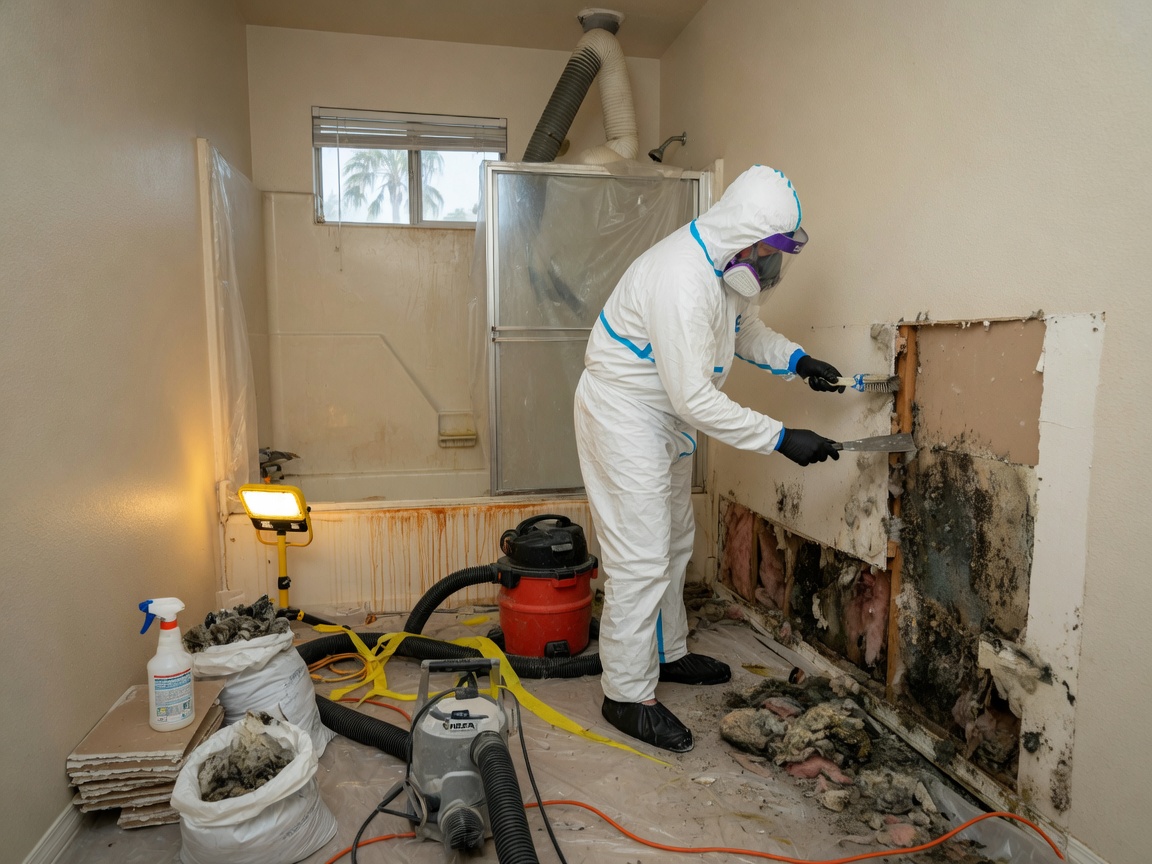
Irvine’s mild Mediterranean climate keeps summers dry but allows cool winter nights to drive condensation inside stucco and wood-frame homes built from the 1970s onward in Northwood and Woodbury. Moisture often collects in attics above vaulted ceilings and in wall cavities where original paper-faced drywall meets exterior sheathing. Left untreated, colonies spread along HVAC returns that serve Great Park and Portola Springs neighborhoods, requiring removal of affected insulation and sometimes subfloor sections.
Many single-family homes in Oak Creek and Quail Hill sit on raised foundations with limited crawl-space ventilation. When irrigation overspray or minor roof leaks introduce water, mold grows on rim joists and sill plates within weeks. Technicians must pull baseboards, cut inspection openings, and apply antimicrobial agents rated for California’s indoor air rules before reinstalling finishes. Failure to address the hidden moisture behind kitchen islands or under bathroom vanities leads to repeat growth within months.
Post-water-event mold in Spectrum Center office condos and nearby apartments frequently involves laminated flooring and acoustic ceiling tiles. Removal crews isolate zones with negative-air machines exhausted through exterior windows to avoid cross-contamination into adjacent units. Salvage decisions hinge on whether particleboard cabinetry has delaminated; owners in Lake Forest and Tustin often learn that insurance covers only the initial water loss, not secondary mold if drying was delayed.
Irvine’s newer Great Park homes use spray-foam insulation that can trap residual moisture against OSB sheathing. Remediation here requires infrared scanning and, in severe cases, removal of foam sections to reach wet wood. Technicians document each step with photos and moisture logs so homeowners in Costa Mesa or Newport Beach understand why certain materials cannot be saved.
Technician insight
In Irvine the thing that catches most people out with mold remediation removal is winter condensation behind stucco in Northwood and Woodbury homes; the paper backing on drywall wicks moisture from cool nights even when no pipe ever leaked, so we always pull baseboards and check the bottom plate before declaring the job done.
Hidden Mold Behind Kitchen Island in Woodbury
A Woodbury homeowner noticed a musty smell after a dishwasher leak two months earlier. Inspection showed mold on the back of the island cabinet and under the laminate flooring. Crews removed the island, treated the subfloor, and dried the wall cavity before reinstalling new cabinetry and flooring.
Mold Remediation Removal Services We Offer
✓Attic Mold Remediation
Removes mold colonies from rafters and insulation in Irvine attics where winter condensation collects above vaulted ceilings.
✓Crawl Space Mold Treatment
Treats mold on joists and vapor barriers in raised-foundation homes common in Woodbury and Oak Creek.
✓Bathroom and Kitchen Mold Removal
Extracts mold from drywall, tile grout, and cabinet bases after leaks in high-humidity rooms.
✓Post-Water Damage Mold Remediation
Addresses secondary mold growth following plumbing or roof leaks in Northwood and Portola Springs properties.
✓HVAC Duct Mold Cleaning
Removes mold inside supply and return ducts that spread spores through homes near the Irvine Spectrum Center.
✓Commercial Space Mold Remediation
Handles mold in office condos and retail spaces around the Irvine Spectrum and adjacent business parks.
Mold Remediation Removal Cost in Irvine, CA
| Service | Typical Range | What Affects It |
|---|---|---|
| Small bathroom or closet remediation | $450–$900 | Limited to one room under 100 sq ft with no hidden wall growth. |
| Attic or crawl space treatment | $1,200–$2,800 | Varies with insulation type and whether rafters or joists require treatment. |
| Whole-room or multi-room job | $2,500–$5,500 | Includes multiple walls, flooring removal, and HVAC cleaning. |
| Post-clearance air testing | $250–$450 | Optional third-party spore count for insurance or real-estate transactions. |
Ranges are typical for Irvine, CA and confirmed with an exact written quote before any work starts.
How it works
- 1
Initial Assessment
Technicians inspect affected rooms, attics, and crawl spaces using moisture meters and infrared cameras to map hidden growth.
- 2
Containment Setup
Plastic barriers and negative-air machines isolate the work zone to prevent spores from reaching unaffected areas of the home.
- 3
Material Removal
Contaminated drywall, insulation, and trim are cut out and bagged for disposal while non-porous surfaces receive antimicrobial treatment.
- 4
Drying And Clearance
Industrial dehumidifiers and air movers dry the structure; post-remediation testing confirms spore levels meet clearance criteria.
Pricing
Cost depends on square footage affected, whether structural materials must be removed, and access difficulty in attics or crawl spaces.